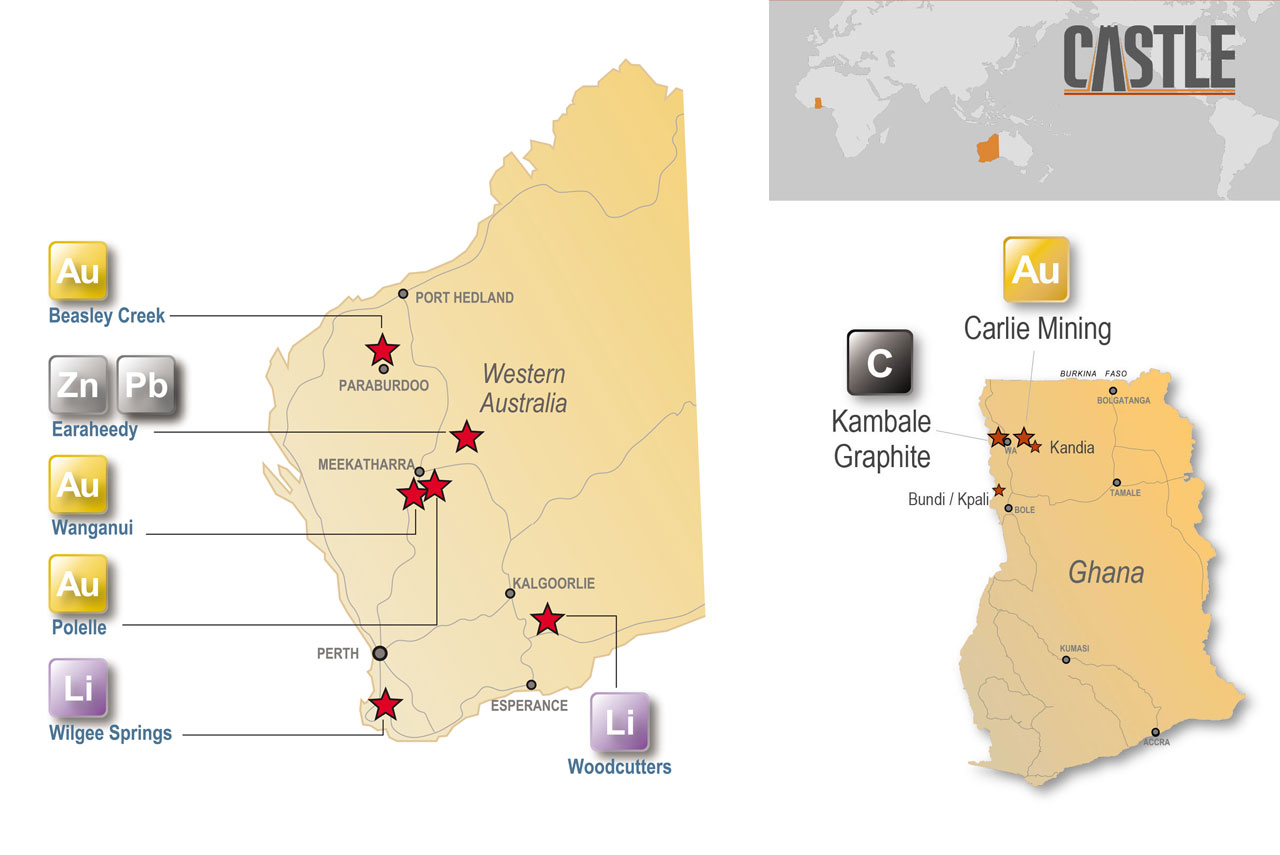
The emerging Kambale graphite project, owned by 100% Ghanaian subsidiary, Kambale Graphite Limited, is located in the country’s Upper West region.
In the same region, Castle’s 100% owned Ghanaian subsidiary, Carlie Mining Ltd, holds a 2,686km² tenure position encompassing large tracts of highly prospective Birimian geological terrane, the host to many of West Africa’s and Ghana’s multi-million-ounce gold mines. It has delineated several advanced gold exploration targets including at Kpali, Bundi and Kandia.
Castle also retains a 4% net smelter precious metal royalty over the Julie West licence, a key component of Azumah Resources Limited’s Wa Gold Project, Upper West region, Ghana.
Western Australia
The Earaheedy Basin project comprises the Withnell and Terra Rossa sub-projects. The Withnell licence is strategically located adjacent to the evolving World-Class Chinook-Magazine zinc-lead project of Rumble Resources Ltd (ASX: RTR) and north of the Strickland Metals Limited (ASX: STK) Iroquois prospect. The Terra Rossa licences have additional prospectivity for copper.
The Beasley Creek project is prospective for gold and lithium and lies on the northern flanks of the Rocklea Dome in the southern Pilbara.
The Polelle project, 7km southeast of the operating Bluebird gold mine near Meekatharra, hosts a mainly obscured and minimally explored greenstone belt prospective for gold and possibly base metals whilst the Wanganui project is prospective for down-plunge high-grade gold shoots.
The Wilgee Springs project, along strike from and within the same metamorphic belt as the world-class Greenbushes lithium mine 25km to the south, is prospective for spodumene bearing pegmatites as is the Woodcutters project, 25km south east of the Bald Hill lithium mine and 25km north west of the Buldania lithium deposit.